
Five Lads Having Fun—and It’s Contagious
A Small-Town Band Built Something Bigger Than Themselves
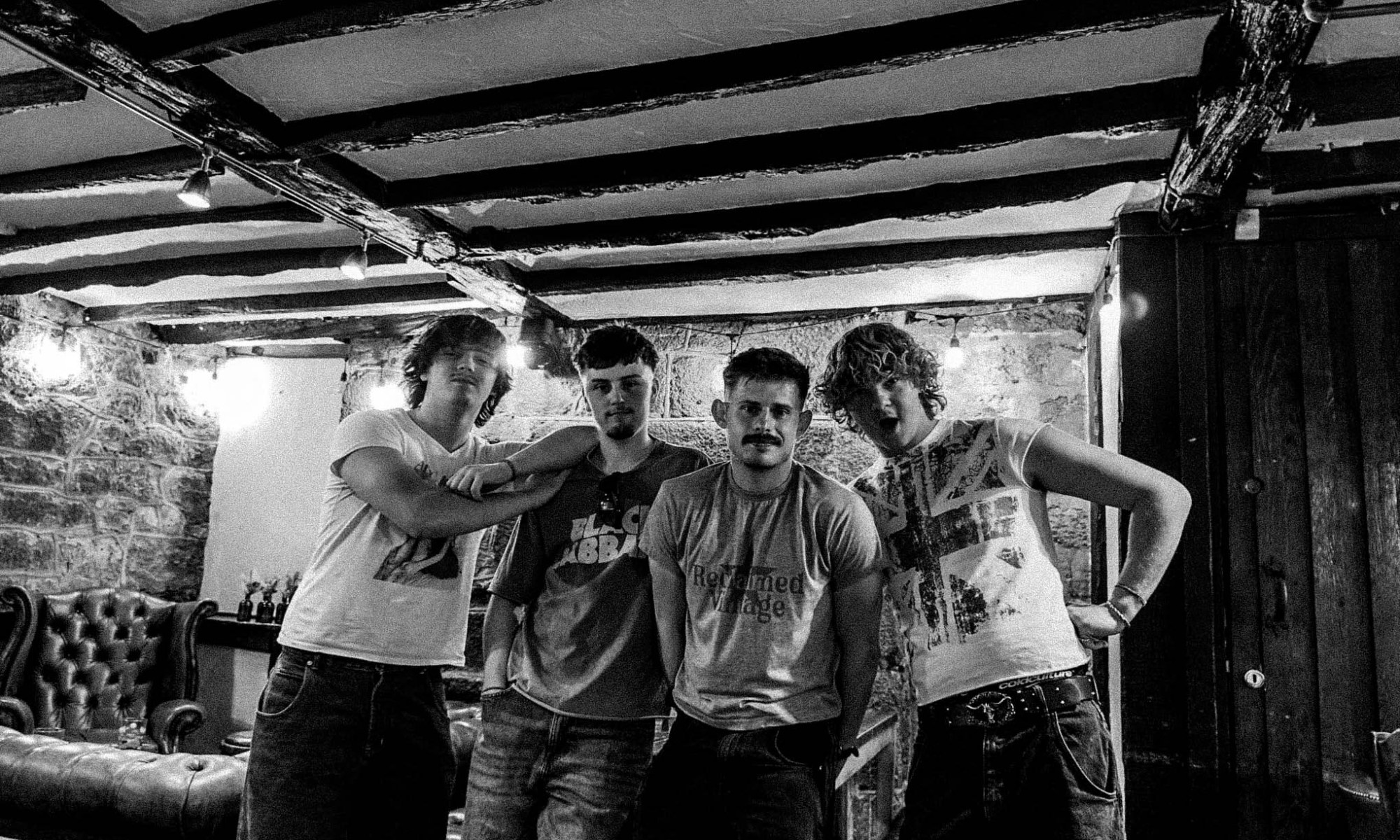
In Ottery St Mary, Devon, in the South West of England, not much happens—at least, not most of the year—until The Kabins turn up: Todd Gilronan on vocals, Elliott Plance on lead guitar, Keiran Reading on rhythm guitar, Freddie Clarke on bass, and Felix Randall on drums.
Aside from the famous Tar Barrels in November, a centuries-old fire festival, it’s the kind of place where quiet routines define everyday life. Live music scenes don’t emerge here naturally. Bands don’t form on every corner.
So when one did, it mattered.
“There just weren’t any bands,” they say. “Apart from Freddie’s dad’s band, that was pretty much it.”
Starting out wasn’t easy. No established scene. No roadmap. No built-in audience. But what Ottery did have—something many bigger cities lack—was community.
And that changed everything.
A Band the Town Could Believe In
When the band played their first gig in April 2022, the expectation was modest: a support slot, a small crowd, a typical local show.
Instead, word spread.
Fast.
“We sold out the venue before the gig even happened,” they recall. “And then we got told—‘you’re headlining.’”
It wasn’t just a good turnout. It was the beginning of something that felt bigger.
“It felt like a bit of a cult following,” they admit.
“In a place like this, everyone knows everyone,” they explain. “So when something happens, people get behind it.”
That support wasn’t a one-off moment either—it stuck. Even as the band has grown, branching into Exeter, Bristol, and London, the same familiar faces continue to appear at gigs.
“A lot of the crowd we see recently would have been there at the very first show,” they say. “That’s really special to us.”
More Than Just a Gig
Part of what made those early shows resonate was simple: they offered something different.
“In Ottery, there’s not much going on apart from the pub,” they say. “So having something on a Saturday night that people could come to, enjoy, and feel part of—that meant a lot.”
For the band, it wasn’t just about performing.
“We enjoyed putting the gigs on as much as people enjoyed coming to them.”
That mutual energy still defines their live shows today.
Five Lads, No Ego
Ask them how they’d describe themselves live, and the answer is refreshingly unpretentious.
“Five lads having fun on stage,” they say.
There’s no obsession with perfection. No rigid choreography. No rockstar detachment.
“We don’t rehearse nearly as much as we should,” they admit, laughing. “It’s very raw.”
But that’s intentional.
“A lot of bands are obsessed with getting everything perfect. But we just want to go out, have a laugh, and enjoy it.”
That looseness translates into something more powerful than precision—connection.
“If you’re bouncing around and enjoying it, the crowd will too. If you’re flat, they’ll feel that.”
Even their stage dynamic reflects that ethos. While there is a lead vocalist, the band avoids the typical frontman structure.
“It doesn’t feel like one person and the rest. Everyone’s involved.”
Built on Shared Creative Ground
That same equality carries into their songwriting.
Typically, a track begins with a simple idea—a chord progression, a riff—recorded on a laptop and shared with the rest of the band. From there, it becomes collaborative.
“We’ll build it up together, then take it into rehearsal,” they explain.
Lyrics, too, are shared territory.
“Anyone can write—Todd, Elliott, Freddie, anyone. It’s all equal.”
That equality isn’t just philosophical—it’s official.
“If you look at our credits, everything is split equally. Everything’s by the band.”
Even ideas that don’t immediately fit are given space.
“No riff gets disregarded, even if it’s weird,” they say. “That’s often where the interesting stuff comes from.”
It’s a process that has evolved over time. Early on, writing was more separate—members developing ideas individually. Now, it’s far more collective.
“With ‘Cherry,’ we actually sat down and wrote it together. That was new for us.”
Cherry — A Step Forward
Set for release on July 17, Cherry represents a turning point.
“It’s definitely the most complete song we’ve done,” they say.
Where earlier tracks might have belonged more clearly to one member, this one feels fully shared.
“It feels more involved. You can hear more musicianship. It’s stronger.”
“It’s not the standard indie route,” they explain. “It’s more emotional, more layered.”
The track blends harmonies, ambient textures—even subtle environmental sounds—with a melodic core designed to stick.
“It’s still something you can sing along to and dance to, but it’s got more depth.”
There’s also a nostalgic undertone running through it—something intentional.
“It has a nostalgic feeling, definitely.”
No Rush for an Album
Despite their growing momentum, the band is cautious about next steps—especially when it comes to an album.
“That’s still a bit pie in the sky,” they admit.
“You only get one debut album. We don’t want to rush it.”
For now, the focus is on refining their sound and building something sustainable.
“The longer we leave it, the better it’ll be.”
Festival Moments That Changed Everything
If Ottery gave them their start, the festival circuit has pushed them further.
Beautiful Days Festival remains one of their most surreal experiences.
Before going on stage, they looked out to see… nothing.
“No one was there,” they say. “We thought we were going to play to three people.”
They regrouped, accepted it—and went out anyway.
“And then suddenly there were thousands of people.”
The shift was instant.
“One minute nothing, the next minute everything. It was surreal.”
Then came the call for Boardmasters—a moment so shocking it caused chaos in a local pub.
“I threw my phone across the room,” one member laughs. “Everyone thought someone had died.”
Instead, it was news that marked a huge step forward.
“We were playing Boardmasters” “(held in Cornwall and arguably the most popular music festival in the South West).”
Influences: From Indie to Metal (and Everything Between)
Their sound reflects a wide mix of influences.
At the surface level are the expected names: The Beatles, Oasis, Arctic Monkeys.
But underneath, it gets far more diverse.
Some members are drawn to artists like The Waterboys, admiring their poetic, imagery-driven lyricism. Others point to Her’s, appreciating their unconventional phrasing and originality.
Then there’s a heavier side.
“Van Halen, Extreme, Black Sabbath,” one member says. “That’s my thing.”
That contrast—indie sensibility meeting heavier musical instincts—creates an unusual blend.
“We all come from different places musically. That’s what makes it interesting.”
They’re also deeply engaged with the local scene.
Bands like Barefoot Bandit and Rootjoose are highlights—not just for their technical skill, but their energy and presence.
“They’re incredibly talented,” they say. “We listen to a lot of local bands.”
Looking Ahead — One Step at a Time
For now, their ambitions are grounded but clear.
They want to expand beyond their current circuit—Exeter, Bristol, London—and reach new cities.
“Brighton’s a big one,” they mention. “The scene there is really strong.”
Even small gigs matter.
“Even if we’re playing to no one, it’s about building connections.”
And longer-term?
“We’ll go to Madrid eventually,” they promise.
Supporters
Football was a shared foundation—supporting teams like Leeds United, Fulham, and **Liverpool—**and some are also rugby fans, particularly Exeter Chiefs.
“I played rugby, cricket, football—everything,” one says.
Another adds a more unexpected passion:
“Darts. I’m really into darts.”
I wouldn’t be surprised if in a few years we find them playing in one of those football stadiums.
The Kabins
Cinco chavales divirtiéndose—y es contagioso
Una banda de pueblo que construyó algo grande
En Ottery St Mary, Devon, en el suroeste de Inglaterra, no pasa gran cosa —al menos, no durante la mayor parte del año— hasta que aparecen The Kabins: Todd Gilronan a la voz, Elliott Plance a la guitarra solista, Keiran Reading a la guitarra rítmica, Freddie Clarke al bajo y Felix Randall a la batería.
Más allá de los famosos Tar Barrels de noviembre, un festival de fuego con siglos de historia, es el tipo de lugar donde las rutinas tranquilas marcan el día a día. Las escenas de música en directo no nacen aquí de forma natural. Las bandas no se forman en cada esquina.
Así que cuando una lo hizo, importó.
«Es que no había bandas», dicen. «Aparte de la banda del padre de Freddie, era prácticamente lo único».
Empezar no fue fácil. Sin escena establecida. Sin hoja de ruta. Sin público asegurado. Pero lo que sí tenía Ottery —algo que a muchas ciudades más grandes les falta— era una comunidad.
Y eso lo cambió todo.
Un grupo en el que el pueblo podía creer
Cuando la banda tocó su primer concierto en abril de 2022, la expectativa era modesta: una actuación de teloneros, un público pequeño, un bolo local típico.
En cambio, el boca a boca corrió.
Rápido.
«Agotamos las entradas del local antes de que el concierto siquiera ocurriera», recuerdan. «Y entonces nos dijeron: ‘vais a ser los cabezas de cartel’».
No fue solo una buena entrada. Fue el inicio de algo que se sentía más grande.
«Parecía un poco un culto», admiten.
«En un sitio como este, todo el mundo conoce a todo el mundo», explican. «Así que cuando pasa algo, la gente se vuelca».
Y aquel apoyo no fue un momento puntual: se mantuvo. Incluso a medida que la banda ha crecido, expandiéndose a Exeter, Bristol y Londres, las mismas caras de siempre siguen apareciendo en los conciertos.
«Mucha de la gente que vemos últimamente habría estado allí en aquel primer show», dicen. «Eso es muy especial para nosotros».
Mucho más que un concierto
Parte de lo que hizo que aquellos primeros bolos conectaran fue algo simple: ofrecían algo distinto.
«En Ottery no hay mucho que hacer aparte del pub», dicen. «Así que tener algo un sábado por la noche a lo que la gente pudiera venir y disfrutar —eso significó mucho».
Para la banda, no se trataba solo de tocar.
«Disfrutábamos montando los conciertos tanto como la gente disfrutaba viniendo».
Esa energía compartida sigue definiendo sus directos hoy.
Cinco chavales, cero ego
Si les preguntas cómo se describirían en directo, la respuesta es refrescantemente poco pretenciosa.
«Cinco chavales pasándolo bien en el escenario», dicen.
No hay obsesión por la perfección. Ni coreografías rígidas. Ni distancias de estrella del rock.
«No ensayamos ni de lejos tanto como deberíamos», admiten, riéndose. «Es todo muy crudo, directo».
Pero eso es intencionado.
«Muchas bandas están obsesionadas con que todo salga perfecto. Pero nosotros solo queremos salir, echarnos unas risas y disfrutar».
Esa soltura se traduce en algo más potente que la precisión: conexión.
«Si estás saltando y disfrutando, el público también lo hará. Si estás siendo algo plano, lo van a notar».
Incluso su dinámica sobre el escenario refleja esa filosofía. Aunque hay un vocalista principal, el grupo evita la estructura típica de frontman.
«No se siente como una persona y el resto. Todo el mundo está implicado».
Construidos sobre un terreno creativo compartido
Esa misma igualdad se traslada a su manera de componer.
Normalmente, una canción empieza con una idea simple —una progresión de acordes, un riff— grabada en un portátil y compartida con el resto de la banda. A partir de ahí, se vuelve colaborativa.
«La vamos construyendo entre todos y luego la llevamos al ensayo», explican.
Las letras, también, son territorio compartido.
«Cualquiera puede escribir: Todd, Elliott, Freddie… cualquiera. Es todo igual».
Esa igualdad no es solo filosófica: es oficial.
«Si miras nuestros créditos, todo está repartido por igual. Todo es de la banda».
Incluso las ideas que no encajan a la primera tienen su espacio.
«Ningún riff se descarta, aunque sea raro», dicen. «A menudo de ahí salen las cosas más interesantes».
Es un proceso que ha evolucionado con el tiempo. Al principio, componer era más por separado —cada miembro desarrollaba ideas individualmente—. Ahora, es mucho más colectivo.
«Con “Cherry”, de hecho nos sentamos y la escribimos juntos. Eso fue nuevo para nosotros».
Cherry — Un paso adelante
Prevista para publicarse el 17 de julio, Cherry representa un punto de inflexión.
«Es, sin duda, la canción más completa que hemos hecho», dicen.
Donde temas anteriores podían pertenecer más claramente a un miembro, este se siente totalmente compartida.
«Se nota más implicación. Se escucha más musicalidad. Es más sólida».
«No es la ruta indie estándar», explican. «Es más emocional, más por capas».
El tema mezcla armonías, texturas ambientales —incluso sutiles sonidos del entorno— con un núcleo melódico pensado para quedarse.
«Sigue siendo algo que puedes cantar y bailar, pero tiene más profundidad».
También recorre la canción un poso nostálgico —algo intencionado—.
«Tiene un punto nostálgico, sin duda».
Sin prisas por un álbum
A pesar de su creciente impulso, la banda va con cautela con los siguientes pasos —especialmente cuando se trata de un álbum—.
«Eso todavía es un poco como castillos en el aire», admiten.
«Solo tienes un album debut. No queremos apresurarnos».
Por ahora, el foco está en afinar su sonido y construir algo sostenible.
«Cuanto más tiempo esperemos, mejor saldrá».
Festivales que lo cambiaron todo
Si Ottery les dio el inicio, el circuito de festivales les ha empujado más allá.
Beautiful Days Festival sigue siendo una de sus experiencias más surrealistas.
Antes de salir al escenario, miraron hacia fuera y vieron… nada.
«No había nadie», dicen. «Pensamos que íbamos a tocar para tres personas».
Se reagruparon, lo aceptaron —y salieron igualmente—.
«Y de repente había miles de personas».
El cambio fue instantáneo.
«Un minuto nada, al siguiente todo. Fue surrealista».
Luego llegó la llamada para Boardmasters —un momento que desató el caos en un pub local—.
«Tiré el móvil al otro lado de la sala», se ríe un miembro. «Todo el mundo pensó que se había muerto alguien».
En realidad, era una noticia que marcaba un gran paso adelante.
«Íbamos a tocar en Boardmasters» “(en Cornwall y, probablemente, el festival de música más popular del suroeste).”
Influencias: del indie al metal (y todo lo que hay entre medias)
Su sonido refleja una mezcla enorme de influencias.
En la superficie están los nombres esperables: The Beatles, Oasis, Arctic Monkeys.
Pero por debajo, se vuelve mucho más diverso.
A algunos miembros les atraen artistas como The Waterboys, por su lirismo poético y lleno de imágenes. Otros señalan a Her’s, por sus giros de frase poco convencionales y su originalidad.
Y luego está el lado más pesado.
«Van Halen, Extreme, Black Sabbath», dice un miembro. «Eso es lo mío».
Ese contraste —sensibilidad indie encontrándose con instintos musicales más duros— crea una mezcla poco habitual.
«Todos venimos de sitios musicales distintos. Eso es lo que lo hace interesante».
También están muy conectados con la escena local.
Bandas como Barefoot Bandit y Rootjoose son de sus favoritas —no solo por su técnica, sino por su energía y presencia—.
«Son increíblemente talentosos», dicen. «Escuchamos un montón de bandas locales».
Mirando hacia delante — paso a paso
Por ahora, sus ambiciones están aterrizadas pero claras.
Quieren expandirse más allá de su circuito actual —Exeter, Bristol, Londres— y llegar a nuevas ciudades.
«Brighton es una grande», mencionan. «La escena allí es muy fuerte».
Incluso los conciertos pequeños cuentan.
«Aunque toquemos para nadie, va de construir conexiones».
¿Y a largo plazo?
«Iremos a Madrid algún día», prometen.
Supporters
El fútbol fue una base compartida —apoyando a equipos como Leeds United, Fulham y Liverpool— y algunos también son aficionados al rugby, especialmente a los Exeter Chiefs.
«Jugué a rugby, críquet, fútbol… a todo», dice uno.
Otro añade una pasión más inesperada:
«Dardos. Me encantan los dardos».
No me sorprendería que dentro de unos años acabemos viéndoles tocar en alguno de esos estadios.
Me estáis descubriendo grupos muy interesantes que desconocía; se me hacen cortas las entrevistas ; enhorabuena y éxito al Kabins